Why a service built on one-to-one work should think about making room for the group

Most services start with one-to-one work. It is familiar, straightforward to structure, easy to control and relatively easy to evidence. There are good reasons for that. But when one-to-one becomes the default, we can start to think about other formats mainly in terms of how well they can reproduce what happens in the one-to-one room.

That can make groupwork look like a way of delivering the same intervention to several people at once, perhaps more efficiently, perhaps more cheaply.

But groups aren’t simply a more economical way of doing individual work. They’re a different resource entirely.

When people work alongside one another, something becomes possible that isn’t available in a one-to-one conversation: the group itself can contribute to the process of change.

Something happens when people hear someone else describe an experience that sounds familiar. They realise they aren’t the only person carrying it. They may notice possibilities they hadn’t considered. They can see their own progress more clearly when they have a chance to put it into words in front of other people, rather than simply telling a practitioner who is listening and taking notes.

And ideas offered by a peer can land differently from the same idea offered by a professional. There is something about hearing, “That happened to me too and this is what I did,” that a practitioner cannot reproduce simply by being skilful.

These aren’t minor additions to one-to-one work. They are resources that simply aren’t available in the one-to-one room.

So a predominantly 1:1 service that adds groupwork isn’t diluting its offer. It is expanding what the service can make possible.

Now take that further: make the groupwork Solution Focused.

There is a problem, though. Groupwork doesn’t automatically make use of the group.

Without specific groupwork training, a session can easily become one-to-one conversation with an audience: the facilitator works through people one at a time while everyone else waits for their turn.

Nothing is inherently wrong with that. But it wastes much of what the group has to offer.

Solution Focused groupwork treats the group itself as part of the intervention.

The facilitator’s task is not to be the source of every useful question, idea or insight. It is to create the conditions in which the group can become a resource for its members.

That means deliberately making use of what is unique about being with other people: witnessing, recognition, peer-generated ideas, different perspectives, encouragement, and the accountability that comes from saying something out loud in front of others.

This isn’t simply a stylistic preference. The emerging evidence for group-delivered Solution Focused Brief Therapy is particularly interesting. A 2024 meta-analysis of 72 studies found that group therapy produced a larger effect (g = 1.64) than individual therapy (g = 0.48).

A separate 2025 meta-analysis examining SFBT research conducted in Iran, covering 34 studies, also found a large and statistically significant effect for group-based Solution Focused Brief Therapy (d = 1.04, p < .001). The authors note that this adds evidence for the effectiveness of group-based SFBT across different populations and presenting problems.

So if a service is already committed to Solution Focused practice, the question isn’t simply whether some of that work could be delivered in groups. It is worth asking what becomes possible when the group itself is deliberately treated as a resource.

That does ask something different of the facilitator.

Holding a Solution Focused group means resisting the pull to comment, teach, rescue or fill every silence. The facilitator has to trust the process enough not to become the centre of it. The skill is less about having something useful to say to everyone and more about creating the conditions in which participants can be useful to one another.

It also changes how the group is designed.

If the group itself is part of the intervention, then the structure of the session matters. The design needs to create opportunities for participants to hear one another, respond to one another, notice successes and differences, share ideas, and build on what others have said.

This means thinking carefully about the movement between whole-group conversation, smaller groups, pairs, individual reflection and other forms of participation. Different structures can serve different purposes: sometimes a participant needs space to think privately; sometimes a smaller conversation creates the safety needed to speak; and sometimes the value lies precisely in bringing an idea back to the whole group and allowing others to respond.

The important thing is not to default to one format, but to design the movement between formats deliberately. If participants spend most of the session having essentially separate conversations with the facilitator or with one other person, the group is not being fully used as a resource.

Good Solution Focused groupwork therefore isn’t simply about what questions the facilitator asks. It is also about how the room is structured so that participants (in person or online) can become resources for one another.

This is why I think services considering groupwork sometimes start with the wrong question.

It can be tempting to ask:

“Why would we offer groups when some people will always prefer one-to-one work?”

And of course, some people will. One-to-one work is an important part of a responsive service, and there will always be circumstances in which it is the right format.

But perhaps the more useful question is:

“What could groupwork make possible that our current ways of working cannot?”

That shifts the conversation away from whether groups should compete with individual work, and towards what each format can uniquely contribute.

The point isn’t to replace one-to-one work with groups. It is to give practitioners another way of working and creating change, one that makes use of the relationships, perspectives and resources that become available when people are working alongside one another.

Want to develop this in practice?

I’m currently running training in Solution Focused Groupwork at BRIEF, for practitioners who want to move beyond delivering one-to-one conversations in a group setting and learn how to use the group itself as a resource.

The training looks at the principles, stance and practical design of Solution Focused groupwork, including how to facilitate participation, generate peer-to-peer resources, and enable conversations so that the group is doing more than simply taking turns with the facilitator.

Find out more about the Solution Focused Groupwork training

References

Vermeulen-Oskam, E., Franklin, C., van ’t Hof, L. P. M., Stams, G. J. J. M., van Vugt, E. S., Assink, M., Veltman, E. J., Froerer, A. S., Staaks, J. P. C., & Zhang, A. (2024). The current evidence of solution-focused brief therapy: A meta-analysis of psychosocial outcomes and moderating factors. Clinical Psychology Review, 114, 102512. https://doi.org/10.1016/j.cpr.2024.102512.

Froerer, A. S., Bolghan-Abadi, M., Chen, M., & Zhang, A. (2025). Meta-analysis of solution-focused brief therapy research conducted in Iran: Does outcome type, intervention modality, or delivery format make a difference? Journal of Marital and Family Therapy, 51(1), e12759. https://doi.org/10.1111/jmft.12759.
Diverse group discussing colorful “Our Journey Together” workshop board
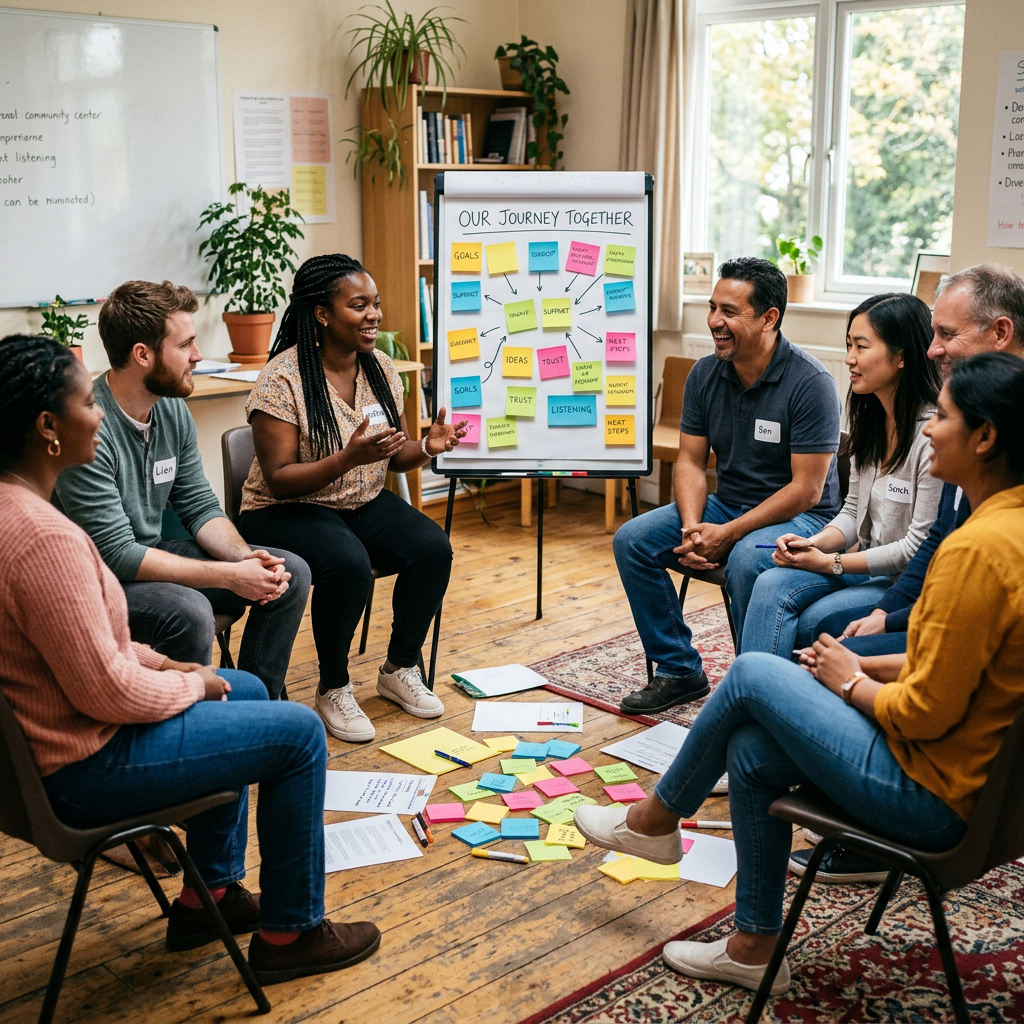
A group collaborates around a colourful “Our Journey Together” group agreement during a community group work.

Online Solution Focused Tool: NEW LIVES FROM BROKEN DREAMS

Dear reader,

a couple of weeks ago, we ran a training together with Chris Iveson, co-founder of BRIEF but also my first supervisor, colleague, co-trainer and a dear friend. Soon after I completed my own SF training at BRIEF, we started doing work together – Chris came to teach with me on my Solution Focused training for professionals in Slovenia in years 2016 and 2017, we presenter together at international conferences, I was BRIEF’s guest to teach at their Diploma and other courses, until they offered me to run a course on my own in 2019 and for the past two years, Chris and I have been working together more closely as co-trainers, with the mission to bring Solution Focused Approach to countries, territories and disciplines where access to training is limited unaffordable and/or doesn’t exist at all. As such we travelled, even in the year of Covid (virtually) to Pakistan, India, Iran and are having activities lined up to travel to Africa and more of Asia in 2021.

The course we recently ran together was about Solution Focused Groupwork – Solution Focused approach for group facilitators. We got lucky for having a privilege to work with a group of 35 marvellous, skilled and dedicated practitioners, so we were already confident (and also hopeful) that two days together would have high chances to result in outstanding outcomes that neither of us could predict at the time we were planning the course.

And one Saturday before the course, my first Guardian paper arrived to our house. Chris has been tempting and nudging me with getting a subscription for years and I have no idea what made me finally agree at the beginning of April 2021. But I do believe that things happen for a reason and in the first paper read in my bed while having coffee and strawberries proved this once again. I was reminiscing about our upcoming course, when this article came up. And then in a blink of an eye, an illuminating thought came to link the metaphor of Kintsugi to the work we do in therapy, coaching and group work. I took a screenshot and sent it to Chris with a text saying “Let’s use this in our course!” and so it began. Before I could start putting my thoughts in shape, Chris had already given it a go with a group of trainees he was with. The response was promising and we started talking. Exploring. Wondering. Trying. Thinking. Hoping. More wondering. More trying. Until an exercise with thought through, deliberate and carefully selected questions was born. We offered this exercise to our group and gave it a proper go with the invite, that participants mute their microphones, but say their answers out loud in our common online space. The beauty of group work is that the facilitators will never know how a certain activity and invite will land and what the participants are capable to do and achieve together as a group. Our group made the exercise better, it brought us new metaphors and language, so we moved from an exercise of “A Broken Pot” to “New lives from broken dreams”. We explored the metaphor of “gold” and introduced a metaphor of “mosaic” rather than a reconstructed pot. So our group has merits that we went beyond the “Art of Repair” which is often associated with Kintsugi, to the art creating new lives. We are thankful to our group for testing this exercise and giving us feedback, which made us want to record it and make it publicly available so that more people can use it, either for themselves as a self help tool, or as an activity used in their group work or training where participants have gone through an experience where their dreams were broken, their hopes dashed, their future destroyed and somehow they are still here.

You can view and try the exercise here:

New lives from broken dreams: a new SF tool

There will be a written form of this exercise coming up too, to make it really inclusive. Chris and I are looking forward to seeing it be used, replicated, cited, taken on new levels, so let us know what you think and how you use(d) it.

Meanwhile – we will run the groupwork course again. When? When the time is right!

With love,

Biba and Chris

2021 has brought a new course: Solution Focused Groupwork with Chris Iveson and Biba Rebolj

Dear reader,

Happy New Year, may it be called a Year of Hope and may it sprout all the seeds you have been planting over 2020!

If I have learned one new thing since the pandemic started, it has been running virtual groups, virtual teams, facilitating virtual meetings and delivering trainings online. And to be honest, I have been enjoying it massively! All the discoveries and possibilities that online environment offers very early on outweighed the doubts and frustrations for not being able to meet face to face. Below is an example of one such event, where Chris and I together delivered a hugely successful post-conference workshop in India. Literally, sky’s become no limit when it comes to running virtual groups. But as they say, it ain’t easy!

Solution Focused approach can be used in a wide variety of fields and settings, ranging from therapy to management, and working with individuals or with groups. Solution Focused Groupwork, whether as therapy, training, support, coaching, or facilitation, and in classes, meetings and other settings, on-line and face-to-face, offers huge potential and can be a very cost-effective, practical and enjoyable way of working with several people at the same time, whether a few or several dozen. It also requires a somewhat different application of Solution Focused skills to those used in individual work. And here’s what Chris and I have prepared for you for 2021: a two day course in Solution Focused Groupwork, that will be delivered online!

In this course, you will explore with Chris and myself how to apply the Solution Focused approach in a variety of settings, both virtual and ‘real’. Chris and I have worked with groups of children, young people, parents, trauma survivors, women in violent relationships, teams and leadership groups. With this experience, together with your experience and skills, you can expect two days of lively, creative, inspiring and highly practical applications of the principles of Solution Focused Groupwork. You will then want to use the what you have learned with your groups immediately, whether you have been working in group settings for a long time, or are thinking of starting to do so. And even if you are already experienced in using the SF approach in your practice, you will gain lots of new skills and ideas from this course.

During our two days together, we will explore the following topics:

  • Off to a good start: group warm up & group contracting
  • Group spirit & formation: building collaboration, safety, curiosity and respect
  • Using the group as a resource to make change simple: preferred future
  • Group discovery of histories of preferred futures: what is already working
  • Using scales in Groupwork
  • Solution Focused negotiating in/with the group
  • Solution Focused debriefing and reflection in groups
  • Group endings: backpack of ideas for after the group stops meeting
  • Various group formats, size, settings and duration: adapting SF
  • How to plan Groupwork & stay SF in it (when things go left instead of right)

This workshop will prove invaluable in providing a core set of basic principles for conducting any type of group I which you want to maximise the constructive contribution of all group members.

Chris Iveson and BRIEF, the leading training provider of Solution Focused Practice, have been my first teachers of SF when I accidentally bumped into it in 2014. And since, have remained my nr. 1. Over the past years, Chris and I grew closer as colleagues, friends and especially since 2019, co-trainers. Having workshops delivered for larger groups as well as boutique teams (in 2020 we visited Pakistan, India and Iran) we discovered that our training styles and diverse experience uniquely complement each other, so we decided to run this course for you.

Chris Iveson founded BRIEF with his colleagues, Evan George and Harvey Ratner in 1989 and with them has been developing the most minimal and simplified version of this world-wide phenomenon, Solution Focused Practice. He is author and co-author of many books about the approach, including the much-translated Solution Focused Brief Therapy: 100 Key Points and Techniques and Brief Coaching: A Solution Focused Approach. A former teacher, social worker and family therapist and manager Chris brings a wealth of experience to both his practice and teaching. He is also a well-respected presenter around the world.

I’ve been working with groups since 2008. My work varies from running groups in formal settings: university tutors, students with disabilities, academic staff, EU commission, Slovenian government as well as non formal education on international level under Erasmus+ and European Solidarity Corps. I’m experienced in running groups as well as teams of various sizes and durations, some of the topics of which include tolerance, youth entrepreneurship, human rights, peace education, inclusion, conflict resolution, stress management, mental health, solidarity and non-formal education.

This course will be epic. Details to register can be accessed here. Chris and I are looking forward to welcome you on board!

With love and from life,

Biba

Biba and Chris