Why a service built on one-to-one work should think about making room for the group

Most services start with one-to-one work. It is familiar, straightforward to structure, easy to control and relatively easy to evidence. There are good reasons for that. But when one-to-one becomes the default, we can start to think about other formats mainly in terms of how well they can reproduce what happens in the one-to-one room.

That can make groupwork look like a way of delivering the same intervention to several people at once, perhaps more efficiently, perhaps more cheaply.

But groups aren’t simply a more economical way of doing individual work. They’re a different resource entirely.

When people work alongside one another, something becomes possible that isn’t available in a one-to-one conversation: the group itself can contribute to the process of change.

Something happens when people hear someone else describe an experience that sounds familiar. They realise they aren’t the only person carrying it. They may notice possibilities they hadn’t considered. They can see their own progress more clearly when they have a chance to put it into words in front of other people, rather than simply telling a practitioner who is listening and taking notes.

And ideas offered by a peer can land differently from the same idea offered by a professional. There is something about hearing, “That happened to me too and this is what I did,” that a practitioner cannot reproduce simply by being skilful.

These aren’t minor additions to one-to-one work. They are resources that simply aren’t available in the one-to-one room.

So a predominantly 1:1 service that adds groupwork isn’t diluting its offer. It is expanding what the service can make possible.

Now take that further: make the groupwork Solution Focused.

There is a problem, though. Groupwork doesn’t automatically make use of the group.

Without specific groupwork training, a session can easily become one-to-one conversation with an audience: the facilitator works through people one at a time while everyone else waits for their turn.

Nothing is inherently wrong with that. But it wastes much of what the group has to offer.

Solution Focused groupwork treats the group itself as part of the intervention.

The facilitator’s task is not to be the source of every useful question, idea or insight. It is to create the conditions in which the group can become a resource for its members.

That means deliberately making use of what is unique about being with other people: witnessing, recognition, peer-generated ideas, different perspectives, encouragement, and the accountability that comes from saying something out loud in front of others.

This isn’t simply a stylistic preference. The emerging evidence for group-delivered Solution Focused Brief Therapy is particularly interesting. A 2024 meta-analysis of 72 studies found that group therapy produced a larger effect (g = 1.64) than individual therapy (g = 0.48).

A separate 2025 meta-analysis examining SFBT research conducted in Iran, covering 34 studies, also found a large and statistically significant effect for group-based Solution Focused Brief Therapy (d = 1.04, p < .001). The authors note that this adds evidence for the effectiveness of group-based SFBT across different populations and presenting problems.

So if a service is already committed to Solution Focused practice, the question isn’t simply whether some of that work could be delivered in groups. It is worth asking what becomes possible when the group itself is deliberately treated as a resource.

That does ask something different of the facilitator.

Holding a Solution Focused group means resisting the pull to comment, teach, rescue or fill every silence. The facilitator has to trust the process enough not to become the centre of it. The skill is less about having something useful to say to everyone and more about creating the conditions in which participants can be useful to one another.

It also changes how the group is designed.

If the group itself is part of the intervention, then the structure of the session matters. The design needs to create opportunities for participants to hear one another, respond to one another, notice successes and differences, share ideas, and build on what others have said.

This means thinking carefully about the movement between whole-group conversation, smaller groups, pairs, individual reflection and other forms of participation. Different structures can serve different purposes: sometimes a participant needs space to think privately; sometimes a smaller conversation creates the safety needed to speak; and sometimes the value lies precisely in bringing an idea back to the whole group and allowing others to respond.

The important thing is not to default to one format, but to design the movement between formats deliberately. If participants spend most of the session having essentially separate conversations with the facilitator or with one other person, the group is not being fully used as a resource.

Good Solution Focused groupwork therefore isn’t simply about what questions the facilitator asks. It is also about how the room is structured so that participants (in person or online) can become resources for one another.

This is why I think services considering groupwork sometimes start with the wrong question.

It can be tempting to ask:

“Why would we offer groups when some people will always prefer one-to-one work?”

And of course, some people will. One-to-one work is an important part of a responsive service, and there will always be circumstances in which it is the right format.

But perhaps the more useful question is:

“What could groupwork make possible that our current ways of working cannot?”

That shifts the conversation away from whether groups should compete with individual work, and towards what each format can uniquely contribute.

The point isn’t to replace one-to-one work with groups. It is to give practitioners another way of working and creating change, one that makes use of the relationships, perspectives and resources that become available when people are working alongside one another.

Want to develop this in practice?

I’m currently running training in Solution Focused Groupwork at BRIEF, for practitioners who want to move beyond delivering one-to-one conversations in a group setting and learn how to use the group itself as a resource.

The training looks at the principles, stance and practical design of Solution Focused groupwork, including how to facilitate participation, generate peer-to-peer resources, and enable conversations so that the group is doing more than simply taking turns with the facilitator.

Find out more about the Solution Focused Groupwork training

References

Vermeulen-Oskam, E., Franklin, C., van ’t Hof, L. P. M., Stams, G. J. J. M., van Vugt, E. S., Assink, M., Veltman, E. J., Froerer, A. S., Staaks, J. P. C., & Zhang, A. (2024). The current evidence of solution-focused brief therapy: A meta-analysis of psychosocial outcomes and moderating factors. Clinical Psychology Review, 114, 102512. https://doi.org/10.1016/j.cpr.2024.102512.

Froerer, A. S., Bolghan-Abadi, M., Chen, M., & Zhang, A. (2025). Meta-analysis of solution-focused brief therapy research conducted in Iran: Does outcome type, intervention modality, or delivery format make a difference? Journal of Marital and Family Therapy, 51(1), e12759. https://doi.org/10.1111/jmft.12759.
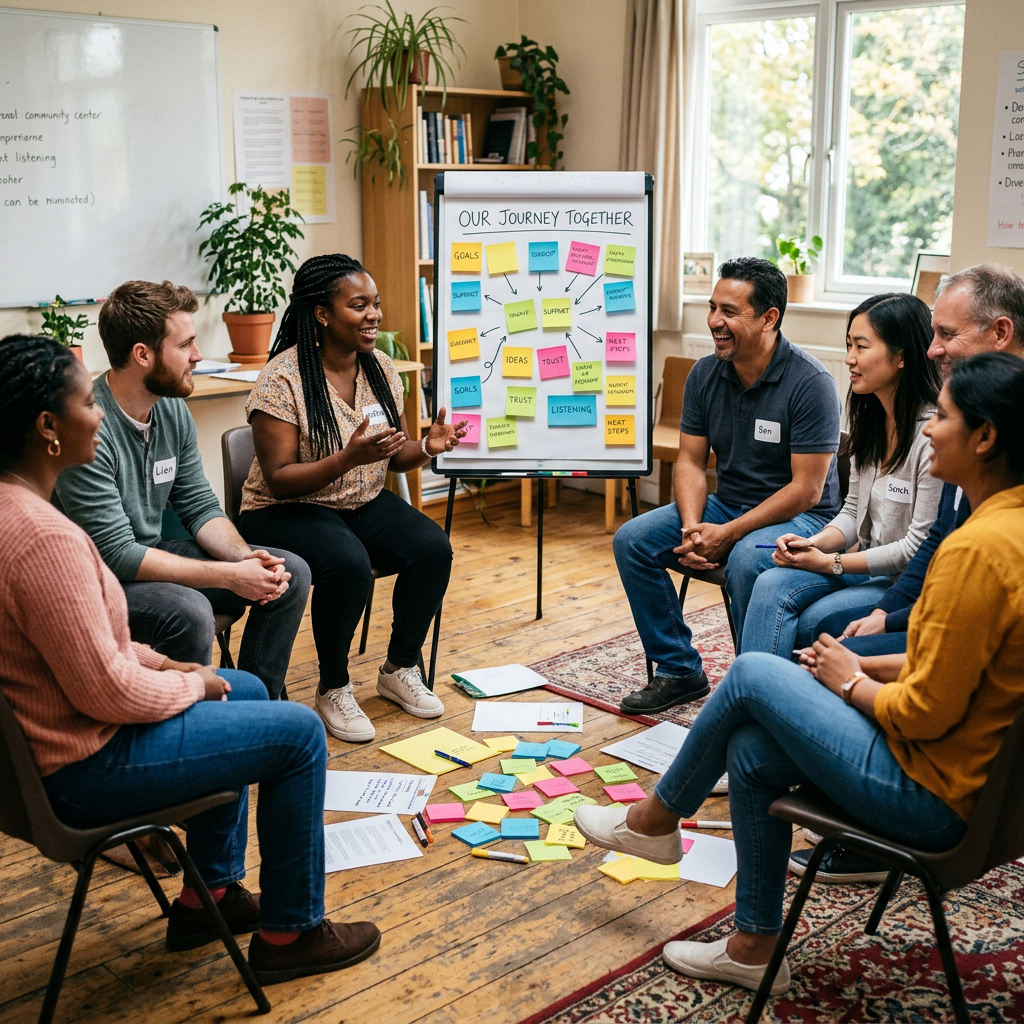
Diverse group discussing colorful “Our Journey Together” workshop board
A group collaborates around a colourful “Our Journey Together” group agreement during a community group work.

Solution Focused Groupwork – a couple of ideas

Dear reader,

Many times queries and inquiries come about how to use Solution Focused Approach to Groupwork. So here are some ideas.

About groups and group work

A group:

  • has members who might or might not know each other,
  • might or might not want to be there,
  • have individual aspirations,
  • have different levels of motivation to participate.
* A group circle centre

Groups are not teams (can be but not necessarily) – Solution Focused process might in some ways be more straightforward with teams because they already have a common goal or direction (or conflict!) but groups may not.

Same as working with individuals, in group work, the Solution Focused worker is totally in the unknown. It is also very likely that participants will not want to cooperate or expose themselves individually (especially adolescents for instance!). However, they might be very happy to get to know their other peers. The worker’s task is to communicate to the participants that they own the group work. Once they take the ownership of the activity, the rest of the process is rather simple. It’s similar to building the contract with individual clients – once you both agree on the direction, the Solution Focused process can start.

Compared to individual work, group work:

  • may be slower at each SF stage (more time for the contract, more time for the preferred future, etc., depending on the group size and facilitator’s approach to working with groups),
  • has a group dynamic going, which can affect the group work (i.e. some participants are more extravert than others, more willing to engage, etc.),
  • there is a risk to lose individual participants to keep the group running,
  • brings huge rewards and pleasure for the worker, as after building the contract (common group agreement and individual hopes), the group does most of the work itself, while the worker steps back, becomes the facilitator the process and holds the space for them.
*Group activity

Below is an example of the whole Solution Focused (SF) group process description. These exercises were developed through lots of failures and some successes working with diverse groups. It is very rare to have an opportunity to run the whole SF process, mainly because of lack of time. If so, you might want to choose what suits a certain group and group aim. Groupwork can pretty much take any facilitation methodology you come up with. If you like music, use music. If you like people to move around a lot, use that. The important thing is to be transparent with the group of what you are inviting them to do (the language of “inviting” rather than “getting” them to do something works better) and give very simple and clear instructions. This way it is likely that the group will perceive you as someone who is with them and will give them a chance to express their aspirations and needs, hence taking over the ownership.

  • Contract or building the platform

a) Introductions – when the group members do not know each other (or do not know each other well):

  • find a partner you don’t know (or don’t know well)
    • think of one thing you’re really pleased about (individually)
    • introduce yourself to your partner (name, what you do/where you come from, etc., what went well)
    • turn to another pair and make a four: introduce your partner by transforming what you heard about them into a compliment.

b) building common agreement (contract): from I to we (suitable for groups up to 50 where the common goal of the group is yet unknown):

  • What is my hope for this event (training, group meeting) as myself?
    • What is my hope from this event (how will I know this activity has been useful for me when it is over and I am back home)?
    • What do I need to function well in the group?
    • What do we need to function well in the group?

Each participant writes individually, then in their fours (or fives if the group is larger) discuss what they’ve written and create some “ingredients for the common agreement”. Then pick one person who will share it with the whole group. The facilitator then introduces the common agreement and a “parking lot” for additional rules and suggestions that might not have been addressed or might occur later.

  • Preferred Future

This can be done with the whole group at once, changing partners with each question. The exercise is exploring what the group members came for with their peers. The point is not to tell what they came for (not to disclose their best hopes)but only describe the difference it would make. If working on individual hopes, the facilitator invites the participants to think of something they want to change in their lives (a positive change). If working on group’s hopes, the miracle will change (insert what the group comes up with as a desired outcome, perhaps take it from the common group agreement).

Make a people carrousel (facing each other, each round changing partners) with questions such as:

  • Think of the weirdest question you could ask (invites them to the miracle, creates a lively atmosphere)
    • What in your life is already going well?
    • Imagine a miracle happened and what you came here for (or the purpose of the activity in case there is a very clear purpose to which everyone agrees) is already happening (is the best activity you ever attended). What would be the first sign to you?
    • What would be different for you in your life, if this miracle happened?
    • What gives you the confidence that you have got the potential to reach your desired outcome (in case it is the common outcome -what is already giving you the clues that you will benefit from this activity hugely?)
    • Which skills and resources are you already possessing that might support you on this journey (in case it is the activity itself, which skills and resources of yours will be most valuable in this group to make this activity worthwhile?)
    • Who would you most like to share your successes with when you return home? Why?
    • What will other group members be noticing about you that will tell them you are benefiting from the activity? (optional, only if everybody really wants to be there).
  • Instances of success

An example of tracking instances of success is the exercise called “Hot seats”. You can change the setting based on whether the group is focused on individual or group outcomes. This exercise is only appropriate when there is enough group trust and enough time for everyone to sit on “hot seats”.

The setting:

  • Having someone present a case/plan/idea
  • Having two or three people asking more details around their case/plan/idea
  • Having the audience tracking instances of success, such as observing what in this idea/plan is already going well. When people in other hot seats stop asking questions, the audience provides appreciative feedback to the person presenting their case/idea.
  • Using scales in group work

Can be done for very different purposes, for instance:

  • to check with the group where we are during the activity (10 is you are benefiting perfectly from the activity and 1 is you are not benefiting at all – on a scale mark where you are currently, then explore together how come it is not lower and what would be the signs of a n+1)
    • to get ideas from peers (scaling walk, useful to close the activity)
    • to track footsteps into signs of progress (useful to close the activity)
    • etc.

Closing

a) When the group is mature and coming towards an end:

Stick papers on each other’s backs. Each participant writes things they appreciated about other participants on their back. They mingle among themselves with the aim to write to as many backs they can. At the same time others will write on their own backs and the key is not to pay attention who is writing on your back.

After 10-15 mins or so (depending on the group’s size), come back and sit in a circle. Take the papers off your back and read it. Pick three things that touched you most and write them on a small piece of paper to keep with you forever. Share in a circle (optional).

b) in crisis situations

Have a cubicle and a list of 6 SF questions such as What do we have to get right, how will we know we are moving forward, What is still working well, etc. and offer participants to randomly throw it at each other. This activity rearranges the power relations and returns the ownership of the activity to the group.

c) final closing

Allow the group to organise itself how they would like to close the activity. It can be sharing in the circle, using some symbol cards (i.e. Dixit cards) and hold the space for their comments, questions, curiosity. 

*All of these exercises can be adapted for online groups, using digital tools.

*Group activity

Hope you found this article useful, do give it a go and share it as you wish. And if you would like to sharpen your skills as a group leader and facilitator, Chris Iveson and myself will run another groupwork course at BRIEF in autumn 2022. These courses are incredible and always lead to new innovations, for example this one from last year:

And some other very useful resources for group activities:

SF Activities: Rohrig, P., & Clarke, J. (Eds.). (2008). 57 SF Activities for Facilitators and Consultants: Putting Solutions Focus Into Action. Solutions Books.

Different methodologies: Salto-youth Toolbox for Training: https://www.salto-youth.net/tools/toolbox/ (accessed on Mar 11th 2022).

Wishing you lots of fun with your groups!

Biba

*A group of international group trainers from Prague