Solution Focused Groupwork – a couple of ideas

Dear reader,

Many times queries and inquiries come about how to use Solution Focused Approach to Groupwork. So here are some ideas.

About groups and group work

A group:

  • has members who might or might not know each other,
  • might or might not want to be there,
  • have individual aspirations,
  • have different levels of motivation to participate.
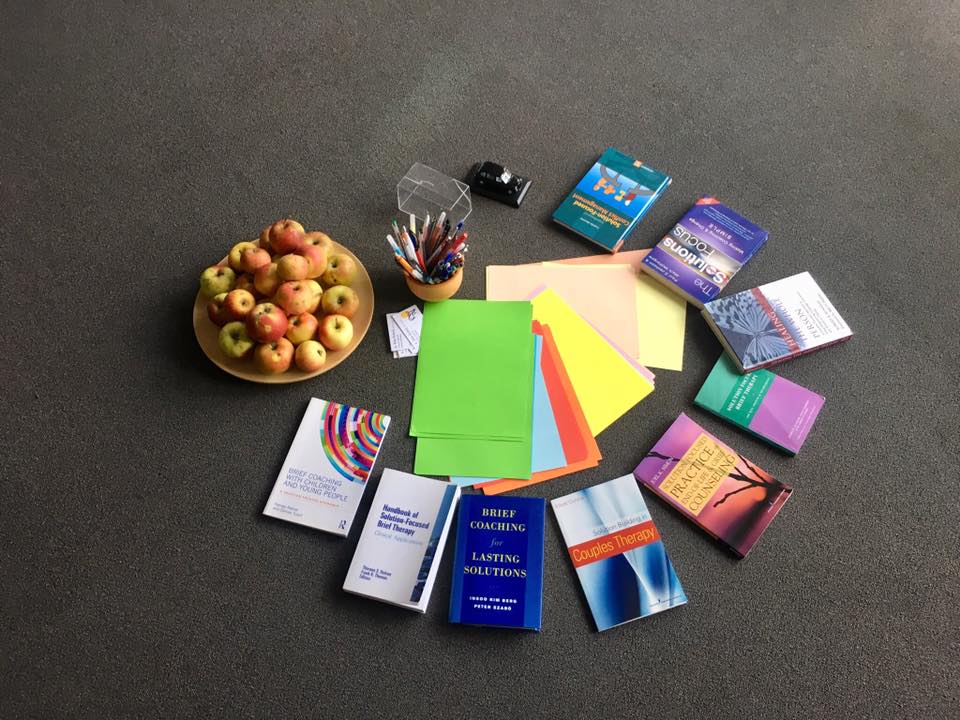
* A group circle centre

Groups are not teams (can be but not necessarily) – Solution Focused process might in some ways be more straightforward with teams because they already have a common goal or direction (or conflict!) but groups may not.

Same as working with individuals, in group work, the Solution Focused worker is totally in the unknown. It is also very likely that participants will not want to cooperate or expose themselves individually (especially adolescents for instance!). However, they might be very happy to get to know their other peers. The worker’s task is to communicate to the participants that they own the group work. Once they take the ownership of the activity, the rest of the process is rather simple. It’s similar to building the contract with individual clients – once you both agree on the direction, the Solution Focused process can start.

Compared to individual work, group work:

  • may be slower at each SF stage (more time for the contract, more time for the preferred future, etc., depending on the group size and facilitator’s approach to working with groups),
  • has a group dynamic going, which can affect the group work (i.e. some participants are more extravert than others, more willing to engage, etc.),
  • there is a risk to lose individual participants to keep the group running,
  • brings huge rewards and pleasure for the worker, as after building the contract (common group agreement and individual hopes), the group does most of the work itself, while the worker steps back, becomes the facilitator the process and holds the space for them.
*Group activity

Below is an example of the whole Solution Focused (SF) group process description. These exercises were developed through lots of failures and some successes working with diverse groups. It is very rare to have an opportunity to run the whole SF process, mainly because of lack of time. If so, you might want to choose what suits a certain group and group aim. Groupwork can pretty much take any facilitation methodology you come up with. If you like music, use music. If you like people to move around a lot, use that. The important thing is to be transparent with the group of what you are inviting them to do (the language of “inviting” rather than “getting” them to do something works better) and give very simple and clear instructions. This way it is likely that the group will perceive you as someone who is with them and will give them a chance to express their aspirations and needs, hence taking over the ownership.

  • Contract or building the platform

a) Introductions – when the group members do not know each other (or do not know each other well):

  • find a partner you don’t know (or don’t know well)
    • think of one thing you’re really pleased about (individually)
    • introduce yourself to your partner (name, what you do/where you come from, etc., what went well)
    • turn to another pair and make a four: introduce your partner by transforming what you heard about them into a compliment.

b) building common agreement (contract): from I to we (suitable for groups up to 50 where the common goal of the group is yet unknown):

  • What is my hope for this event (training, group meeting) as myself?
    • What is my hope from this event (how will I know this activity has been useful for me when it is over and I am back home)?
    • What do I need to function well in the group?
    • What do we need to function well in the group?

Each participant writes individually, then in their fours (or fives if the group is larger) discuss what they’ve written and create some “ingredients for the common agreement”. Then pick one person who will share it with the whole group. The facilitator then introduces the common agreement and a “parking lot” for additional rules and suggestions that might not have been addressed or might occur later.

  • Preferred Future

This can be done with the whole group at once, changing partners with each question. The exercise is exploring what the group members came for with their peers. The point is not to tell what they came for (not to disclose their best hopes)but only describe the difference it would make. If working on individual hopes, the facilitator invites the participants to think of something they want to change in their lives (a positive change). If working on group’s hopes, the miracle will change (insert what the group comes up with as a desired outcome, perhaps take it from the common group agreement).

Make a people carrousel (facing each other, each round changing partners) with questions such as:

  • Think of the weirdest question you could ask (invites them to the miracle, creates a lively atmosphere)
    • What in your life is already going well?
    • Imagine a miracle happened and what you came here for (or the purpose of the activity in case there is a very clear purpose to which everyone agrees) is already happening (is the best activity you ever attended). What would be the first sign to you?
    • What would be different for you in your life, if this miracle happened?
    • What gives you the confidence that you have got the potential to reach your desired outcome (in case it is the common outcome -what is already giving you the clues that you will benefit from this activity hugely?)
    • Which skills and resources are you already possessing that might support you on this journey (in case it is the activity itself, which skills and resources of yours will be most valuable in this group to make this activity worthwhile?)
    • Who would you most like to share your successes with when you return home? Why?
    • What will other group members be noticing about you that will tell them you are benefiting from the activity? (optional, only if everybody really wants to be there).
  • Instances of success

An example of tracking instances of success is the exercise called “Hot seats”. You can change the setting based on whether the group is focused on individual or group outcomes. This exercise is only appropriate when there is enough group trust and enough time for everyone to sit on “hot seats”.

The setting:

  • Having someone present a case/plan/idea
  • Having two or three people asking more details around their case/plan/idea
  • Having the audience tracking instances of success, such as observing what in this idea/plan is already going well. When people in other hot seats stop asking questions, the audience provides appreciative feedback to the person presenting their case/idea.
  • Using scales in group work

Can be done for very different purposes, for instance:

  • to check with the group where we are during the activity (10 is you are benefiting perfectly from the activity and 1 is you are not benefiting at all – on a scale mark where you are currently, then explore together how come it is not lower and what would be the signs of a n+1)
    • to get ideas from peers (scaling walk, useful to close the activity)
    • to track footsteps into signs of progress (useful to close the activity)
    • etc.

Closing

a) When the group is mature and coming towards an end:

Stick papers on each other’s backs. Each participant writes things they appreciated about other participants on their back. They mingle among themselves with the aim to write to as many backs they can. At the same time others will write on their own backs and the key is not to pay attention who is writing on your back.

After 10-15 mins or so (depending on the group’s size), come back and sit in a circle. Take the papers off your back and read it. Pick three things that touched you most and write them on a small piece of paper to keep with you forever. Share in a circle (optional).

b) in crisis situations

Have a cubicle and a list of 6 SF questions such as What do we have to get right, how will we know we are moving forward, What is still working well, etc. and offer participants to randomly throw it at each other. This activity rearranges the power relations and returns the ownership of the activity to the group.

c) final closing

Allow the group to organise itself how they would like to close the activity. It can be sharing in the circle, using some symbol cards (i.e. Dixit cards) and hold the space for their comments, questions, curiosity. 

*All of these exercises can be adapted for online groups, using digital tools.

*Group activity

Hope you found this article useful, do give it a go and share it as you wish. And if you would like to sharpen your skills as a group leader and facilitator, Chris Iveson and myself will run another groupwork course at BRIEF in autumn 2022. These courses are incredible and always lead to new innovations, for example this one from last year:

And some other very useful resources for group activities:

SF Activities: Rohrig, P., & Clarke, J. (Eds.). (2008). 57 SF Activities for Facilitators and Consultants: Putting Solutions Focus Into Action. Solutions Books.

Different methodologies: Salto-youth Toolbox for Training: https://www.salto-youth.net/tools/toolbox/ (accessed on Mar 11th 2022).

Wishing you lots of fun with your groups!

Biba

*A group of international group trainers from Prague

What if vs. what is: why Solution Focused approach isn’t about the positive

Dear reader,

nowadays you may come across many tips, strategies and theories that are solution-focused, future oriented and try to emphasise the positive, like:

  • positive affirmations
  • visualisation
  • CBT
  • NLP
  • positive psychology
  • growth mindset
  • etc.

What these approaches all have in common is, that they steer away from looking for what’s wrong and instead focus on the opposite: what’s working, positive, what’s wanted, etc. If taking for example, they are focusing on what if (your life was XXX – insert the preferred term). We have got quite some evidence showing that for instance, expressing gratitude, writing letters of appreciation, practising positivity and the like tasks, bring about fruitful results. And we also have evidence that in many cases these results do not last.

I do not wish to go into the discussion and critique other approaches. But I do wish to draw the line of what makes Solution Focused approach different to other solution and future oriented approaches. So here are a few of my arguments:

  • Solution Focused is not about solutions. It is about the solution context, as Evan George from BRIEF likes to say. Which makes SF not interested in concrete action, steps, which in many cases do not happen for various reasons. It is instead interested in signs. Which are always present, regardless of the action.
  • Solution Focused is about preferred future. It stays close to the description of the client’s future, therefore we do not insert any adjectives such as positive, better, grand, fulfilling, etc. We simply call it “preferred”, which means that our clients define what preferred is. Thus we are not emphasising the positives. Which brings me to:
  • Solution Focused is not about the positive. It is about what is wanted and what is working. For instance, if a client whose partner died tragically in an accident, for such client the term “positive” may not suit, as it is overly ambitious and all in all, not suitable. Still, they may want to find comfort, peace or just time to pause and deal with grief and loss. Many people do not live lives that enable them to even think about positive. This does not mean that they have stopped living, though some of them might have tried to end their lives.
  • Solution Focused has no agenda of what is working. The previously mentioned evidence which shows correlation of certain tasks with desired change, is left aside in SF approach. Simply because it comes from research and thus leaves a possibility that it might not work for our client. Instead, we believe that our clients are capable of designing their own strategies of what is working for them and more, they already have the skills and resources to follow these strategies if they choose to do so. Oddly, SF research shows, that when the practitioner lets go of their own agenda, their willingness to offer useful tips and advice as well as let go of being interested in what clients will do after the session, clients’ progress towards change happens faster. Thus, tasks are not necessary and may even be a burden to change.
  • Solution Focused is not following “fake it till you make it” rule. Yes, it does work with the “what if” concept, but it rather brings it into description of “what is”. Therefore, it does not require effort to pretend the “what if”, instead it invites our clients to notice the “what if” into “what is”. Again, emphasis is on working with concepts and descriptions our clients give us – not what we think they might need or want.

This may sound simple. And it is. There is no grand theory or vast knowledge in the practitioner’s purse and backpack. Instead they come into the conversation as a blank page and try not to read between the lines, either trying to figure out what the client “really” wants and “really” says. But this is far from easy. Whenever I train professionals in SF, they say after trying out a couple of exercises, that this is the hardest part. I couldn’t agree more. And this makes a profound distinction comparing SF to any other approach, even though the core interest and focus may be the same. But SF’s viewpoint and paradigm make it very, very unique. Which in my opinion allows it to be effective with people, who find themselves in all sort of life situations, across cultures and with different levels of motivation or abilities to make change happen.

This autumn, I will be going new places to teach Solution Focused Brief Therapy: Georgia in September, Greece in October and India in December. I cannot wait to meet new professionals, explore SF with them and share my passion.

Biba

IMG_8136

A poster I often use in my trainings. Everybody has preferred future – but it makes a big difference who defines it and how.

A Patient Cured is a Customer Lost (about ethics in therapy and coaching)

Dear reader,

This came across as I was sipping my morning coffee. In therapy and coaching, there are numerous examples of unethical practices and behaviours. One of them is surely keeping clients in therapy or coaching process longer than necessary and useful for them and sometimes these intentions might be profit driven.

When I deliver trainings in Solution Focused Practice for professionals around the EU and UK, I often tell them that if they want to become rich, they have to change to another modality. SF process is brief and if one is surviving on clients only, one might either become really good at constantly and frequently attracting new clients, or make their living elsewhere (or be unethical, which I will not consider at all atm).

Solution Focused Practice will invite you to think about your preferred future. It will help you describe new ways of living for yourself and might open up new possibilities of a future you consider worth living. It will not tell you what to do and will not provide an explanation of why you haven’t managed to get there yet (or reversed, why you have been in the situation you do not want to be in). The research across cultures, countries and settings shows to have lasting effects comparable to any other type of therapy or coaching, with the difference that you arrive at your desired outcome faster. So why do more, when you can do less? Why spend half of your life in therapy if there are other, faster and lighter options with the same outlooks?

And one more thing re below picture. Therapy and coaching in my modest opinion, are not business services. They should not correlate to one’s ability to pay or afford it. The practitioner should always strive to be brief – not do one session more than what is absolutely necessary. And the “necessity” should always be determined by the client, not your expert opinion. So when the patient feels well, they should not be given extra drugs “just in case” or when the client feels they are able to move on or live their life in the way that is right for them, they should not be imposed another session “just in case”. If they ask for it, that’s a different thing altogether.

So whenever you meet a therapist or coach who will tell you in advance how many sessions it will take, walk away. They have no ways of knowing and their theories are merely theories – they help us think, but not always act.

Some Monday, huh? Wish you a good week ahead,

Biba

53566842_2105081079577800_1898796584770994176_n

Borrowed from Facebook.


People don’t want to be taught, people want to be inspired!

Dear reader,

our first chapter of Slovenian Professional Solution Focused Training is behind us. Two amazing days full of joy, newly discovered passion and constructing new knowledge together.

In solution focused conversations, one of the important skills is to stay on the surface and not try to read between the lines. Because there might be nothing there actually. This is harder to do than to say, but hey, talking about solution focus is very different to doing solution focus.

People are tempted to give advice and teach others how they are supposed to live their lives. We like to offer our suggestions and share our wisdom. And what we like even more is to pressupose what’s happening in another person’s mind. And then analyze, discuss and conclude on their behalf. And be content with our so called “expertise” a tap on the shoulder and thinking “well done”, I did such a great job and helped that person immensely.

Did you?

From my experience, I hate it when people try to give me an advice I didn’t ask for (and they do it daily). I get goose bumps when people begin to explain to me what’s happening with me and why I’m feeling or thinking in a certain way. I get allergic when somebody discusses another one’s behaviour with a third person and nodding their heads as if they were true experts. Just because I don’t say anything doesn’t mean I want you to say something instead of me on my behalf. My husband told me he used to be with somebody who always interpreted for him what he was thinking, why he was or wasn’t doing something and how he should change. So what he did or what he didn’t do, why and how this was wrong. He said it was a nightmare (who wouldn’t?). However occasionally I notice I’m no better though 🙂

Staying on the surface means that you let the other person be the expert of their lives. It was never meant to be your position. We talk way too much and we think others ask for our opinion. In most cases they don’t really. There are so many people who talk about themselves all the time and think others appreciate it. They are most probably bored or annoyed. The world isn’t spinning around you and it’s not about you all the time, when you’re talking to another person.

My experience is that people don’t like to be taught. One of the worst things you could say to another person is: “I told you so” or “I knew this was gonna happen” (now let me fix you …). It’s such a pity to close the space by forcing and pushing people with your opinion and values. A pity because you don’t let the other’s resources come to the surface. So you don’t learn anything new, but merely repeat what you already know. And this is not how new knowledge is created.

These blogs I write are far away from lessons. I hope my readers perceive it more as invitations to think about their own behaviour and practice. I can only offer what I’ve learned. But I can’t teach others, because I don’t know how to teach them and also don’t want to teach them. They know how they like to be addressed, so it’s more of a self service and not a compulsory menu.

People don’t like to be taught. But we do like to get inspired by stories, by invitations to co-create, to connect, to listen to each other. To let others come to our personal space and to step into theirs. To be genuinely interested in what the other person has to say and to build on their previous wisdom. This is how ideas are born, this is how meaningful conversations happen. It takes two to have a conversation in pairs. Two listeners and two talkers. Two way conversation can’t be done if there’s only one talking and taking. Especially if he or she dares to speak in another person’s name. This is disrespectful and rude. No wonder people don’t behave the way you want them to. You’re not the one to tell them what to do. And you’re not the one to translate and interpret their thoughts. Because they know better. In fact, they are the only ones who know anything.

Told you Solution Focus was easy to learn and hard to do 🙂

Happy conversations!

Biba

07D_3346.JPG

First generation of Slovenian Solution Focused People!