Solution Focused Groupwork – a couple of ideas

Dear reader,

Many times queries and inquiries come about how to use Solution Focused Approach to Groupwork. So here are some ideas.

About groups and group work

A group:

  • has members who might or might not know each other,
  • might or might not want to be there,
  • have individual aspirations,
  • have different levels of motivation to participate.
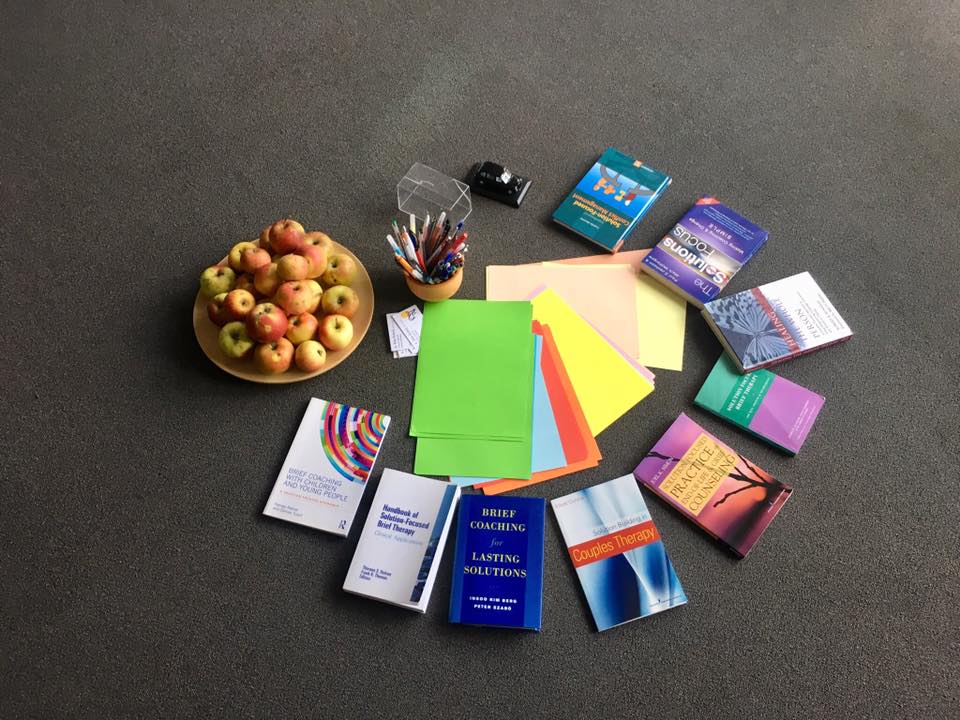
* A group circle centre

Groups are not teams (can be but not necessarily) – Solution Focused process might in some ways be more straightforward with teams because they already have a common goal or direction (or conflict!) but groups may not.

Same as working with individuals, in group work, the Solution Focused worker is totally in the unknown. It is also very likely that participants will not want to cooperate or expose themselves individually (especially adolescents for instance!). However, they might be very happy to get to know their other peers. The worker’s task is to communicate to the participants that they own the group work. Once they take the ownership of the activity, the rest of the process is rather simple. It’s similar to building the contract with individual clients – once you both agree on the direction, the Solution Focused process can start.

Compared to individual work, group work:

  • may be slower at each SF stage (more time for the contract, more time for the preferred future, etc., depending on the group size and facilitator’s approach to working with groups),
  • has a group dynamic going, which can affect the group work (i.e. some participants are more extravert than others, more willing to engage, etc.),
  • there is a risk to lose individual participants to keep the group running,
  • brings huge rewards and pleasure for the worker, as after building the contract (common group agreement and individual hopes), the group does most of the work itself, while the worker steps back, becomes the facilitator the process and holds the space for them.
*Group activity

Below is an example of the whole Solution Focused (SF) group process description. These exercises were developed through lots of failures and some successes working with diverse groups. It is very rare to have an opportunity to run the whole SF process, mainly because of lack of time. If so, you might want to choose what suits a certain group and group aim. Groupwork can pretty much take any facilitation methodology you come up with. If you like music, use music. If you like people to move around a lot, use that. The important thing is to be transparent with the group of what you are inviting them to do (the language of “inviting” rather than “getting” them to do something works better) and give very simple and clear instructions. This way it is likely that the group will perceive you as someone who is with them and will give them a chance to express their aspirations and needs, hence taking over the ownership.

  • Contract or building the platform

a) Introductions – when the group members do not know each other (or do not know each other well):

  • find a partner you don’t know (or don’t know well)
    • think of one thing you’re really pleased about (individually)
    • introduce yourself to your partner (name, what you do/where you come from, etc., what went well)
    • turn to another pair and make a four: introduce your partner by transforming what you heard about them into a compliment.

b) building common agreement (contract): from I to we (suitable for groups up to 50 where the common goal of the group is yet unknown):

  • What is my hope for this event (training, group meeting) as myself?
    • What is my hope from this event (how will I know this activity has been useful for me when it is over and I am back home)?
    • What do I need to function well in the group?
    • What do we need to function well in the group?

Each participant writes individually, then in their fours (or fives if the group is larger) discuss what they’ve written and create some “ingredients for the common agreement”. Then pick one person who will share it with the whole group. The facilitator then introduces the common agreement and a “parking lot” for additional rules and suggestions that might not have been addressed or might occur later.

  • Preferred Future

This can be done with the whole group at once, changing partners with each question. The exercise is exploring what the group members came for with their peers. The point is not to tell what they came for (not to disclose their best hopes)but only describe the difference it would make. If working on individual hopes, the facilitator invites the participants to think of something they want to change in their lives (a positive change). If working on group’s hopes, the miracle will change (insert what the group comes up with as a desired outcome, perhaps take it from the common group agreement).

Make a people carrousel (facing each other, each round changing partners) with questions such as:

  • Think of the weirdest question you could ask (invites them to the miracle, creates a lively atmosphere)
    • What in your life is already going well?
    • Imagine a miracle happened and what you came here for (or the purpose of the activity in case there is a very clear purpose to which everyone agrees) is already happening (is the best activity you ever attended). What would be the first sign to you?
    • What would be different for you in your life, if this miracle happened?
    • What gives you the confidence that you have got the potential to reach your desired outcome (in case it is the common outcome -what is already giving you the clues that you will benefit from this activity hugely?)
    • Which skills and resources are you already possessing that might support you on this journey (in case it is the activity itself, which skills and resources of yours will be most valuable in this group to make this activity worthwhile?)
    • Who would you most like to share your successes with when you return home? Why?
    • What will other group members be noticing about you that will tell them you are benefiting from the activity? (optional, only if everybody really wants to be there).
  • Instances of success

An example of tracking instances of success is the exercise called “Hot seats”. You can change the setting based on whether the group is focused on individual or group outcomes. This exercise is only appropriate when there is enough group trust and enough time for everyone to sit on “hot seats”.

The setting:

  • Having someone present a case/plan/idea
  • Having two or three people asking more details around their case/plan/idea
  • Having the audience tracking instances of success, such as observing what in this idea/plan is already going well. When people in other hot seats stop asking questions, the audience provides appreciative feedback to the person presenting their case/idea.
  • Using scales in group work

Can be done for very different purposes, for instance:

  • to check with the group where we are during the activity (10 is you are benefiting perfectly from the activity and 1 is you are not benefiting at all – on a scale mark where you are currently, then explore together how come it is not lower and what would be the signs of a n+1)
    • to get ideas from peers (scaling walk, useful to close the activity)
    • to track footsteps into signs of progress (useful to close the activity)
    • etc.

Closing

a) When the group is mature and coming towards an end:

Stick papers on each other’s backs. Each participant writes things they appreciated about other participants on their back. They mingle among themselves with the aim to write to as many backs they can. At the same time others will write on their own backs and the key is not to pay attention who is writing on your back.

After 10-15 mins or so (depending on the group’s size), come back and sit in a circle. Take the papers off your back and read it. Pick three things that touched you most and write them on a small piece of paper to keep with you forever. Share in a circle (optional).

b) in crisis situations

Have a cubicle and a list of 6 SF questions such as What do we have to get right, how will we know we are moving forward, What is still working well, etc. and offer participants to randomly throw it at each other. This activity rearranges the power relations and returns the ownership of the activity to the group.

c) final closing

Allow the group to organise itself how they would like to close the activity. It can be sharing in the circle, using some symbol cards (i.e. Dixit cards) and hold the space for their comments, questions, curiosity. 

*All of these exercises can be adapted for online groups, using digital tools.

*Group activity

Hope you found this article useful, do give it a go and share it as you wish. And if you would like to sharpen your skills as a group leader and facilitator, Chris Iveson and myself will run another groupwork course at BRIEF in autumn 2022. These courses are incredible and always lead to new innovations, for example this one from last year:

And some other very useful resources for group activities:

SF Activities: Rohrig, P., & Clarke, J. (Eds.). (2008). 57 SF Activities for Facilitators and Consultants: Putting Solutions Focus Into Action. Solutions Books.

Different methodologies: Salto-youth Toolbox for Training: https://www.salto-youth.net/tools/toolbox/ (accessed on Mar 11th 2022).

Wishing you lots of fun with your groups!

Biba

*A group of international group trainers from Prague

New webinar on Wednesday: Introduction to Solution Focused Approach and a free intro training

Dear reader,

you might have been puzzled or intrigued by all the talk and chatter about the Solution Focused Approach. This site hopefully provides some sort of start so that you can get an idea of what that is, but if you’d like to know more, I’m pleased to announce that this upcoming Wednesday I am hosting a short webinar on the topic.

In the webinar, I’m going to walk you through and introducing you to an approach that changed my professional (and bits of personal) life. If you’ll feel like this might be for you, I’ll also present an opportunity for you to get trained in the basics of the approach – for free. For the past year, we have worked hard with partners from Estonia and Poland to make this happen and now it’s finally here – a brand new online training that will teach you the basics and in this webinar I’ll be so pleased to give you a chance to see it and later on try it yourself should you wish to.

If you’d like to attend the webinar, please register here.

Hope to see you on Wednesday, 9am GMT+1 (10am CET).

With love,

Biba

Online Solution Focused Tool: NEW LIVES FROM BROKEN DREAMS

Dear reader,

a couple of weeks ago, we ran a training together with Chris Iveson, co-founder of BRIEF but also my first supervisor, colleague, co-trainer and a dear friend. Soon after I completed my own SF training at BRIEF, we started doing work together – Chris came to teach with me on my Solution Focused training for professionals in Slovenia in years 2016 and 2017, we presenter together at international conferences, I was BRIEF’s guest to teach at their Diploma and other courses, until they offered me to run a course on my own in 2019 and for the past two years, Chris and I have been working together more closely as co-trainers, with the mission to bring Solution Focused Approach to countries, territories and disciplines where access to training is limited unaffordable and/or doesn’t exist at all. As such we travelled, even in the year of Covid (virtually) to Pakistan, India, Iran and are having activities lined up to travel to Africa and more of Asia in 2021.

The course we recently ran together was about Solution Focused Groupwork – Solution Focused approach for group facilitators. We got lucky for having a privilege to work with a group of 35 marvellous, skilled and dedicated practitioners, so we were already confident (and also hopeful) that two days together would have high chances to result in outstanding outcomes that neither of us could predict at the time we were planning the course.

And one Saturday before the course, my first Guardian paper arrived to our house. Chris has been tempting and nudging me with getting a subscription for years and I have no idea what made me finally agree at the beginning of April 2021. But I do believe that things happen for a reason and in the first paper read in my bed while having coffee and strawberries proved this once again. I was reminiscing about our upcoming course, when this article came up. And then in a blink of an eye, an illuminating thought came to link the metaphor of Kintsugi to the work we do in therapy, coaching and group work. I took a screenshot and sent it to Chris with a text saying “Let’s use this in our course!” and so it began. Before I could start putting my thoughts in shape, Chris had already given it a go with a group of trainees he was with. The response was promising and we started talking. Exploring. Wondering. Trying. Thinking. Hoping. More wondering. More trying. Until an exercise with thought through, deliberate and carefully selected questions was born. We offered this exercise to our group and gave it a proper go with the invite, that participants mute their microphones, but say their answers out loud in our common online space. The beauty of group work is that the facilitators will never know how a certain activity and invite will land and what the participants are capable to do and achieve together as a group. Our group made the exercise better, it brought us new metaphors and language, so we moved from an exercise of “A Broken Pot” to “New lives from broken dreams”. We explored the metaphor of “gold” and introduced a metaphor of “mosaic” rather than a reconstructed pot. So our group has merits that we went beyond the “Art of Repair” which is often associated with Kintsugi, to the art creating new lives. We are thankful to our group for testing this exercise and giving us feedback, which made us want to record it and make it publicly available so that more people can use it, either for themselves as a self help tool, or as an activity used in their group work or training where participants have gone through an experience where their dreams were broken, their hopes dashed, their future destroyed and somehow they are still here.

You can view and try the exercise here:

New lives from broken dreams: a new SF tool

There will be a written form of this exercise coming up too, to make it really inclusive. Chris and I are looking forward to seeing it be used, replicated, cited, taken on new levels, so let us know what you think and how you use(d) it.

Meanwhile – we will run the groupwork course again. When? When the time is right!

With love,

Biba and Chris

2021 has brought a new course: Solution Focused Groupwork with Chris Iveson and Biba Rebolj

Dear reader,

Happy New Year, may it be called a Year of Hope and may it sprout all the seeds you have been planting over 2020!

If I have learned one new thing since the pandemic started, it has been running virtual groups, virtual teams, facilitating virtual meetings and delivering trainings online. And to be honest, I have been enjoying it massively! All the discoveries and possibilities that online environment offers very early on outweighed the doubts and frustrations for not being able to meet face to face. Below is an example of one such event, where Chris and I together delivered a hugely successful post-conference workshop in India. Literally, sky’s become no limit when it comes to running virtual groups. But as they say, it ain’t easy!

Solution Focused approach can be used in a wide variety of fields and settings, ranging from therapy to management, and working with individuals or with groups. Solution Focused Groupwork, whether as therapy, training, support, coaching, or facilitation, and in classes, meetings and other settings, on-line and face-to-face, offers huge potential and can be a very cost-effective, practical and enjoyable way of working with several people at the same time, whether a few or several dozen. It also requires a somewhat different application of Solution Focused skills to those used in individual work. And here’s what Chris and I have prepared for you for 2021: a two day course in Solution Focused Groupwork, that will be delivered online!

In this course, you will explore with Chris and myself how to apply the Solution Focused approach in a variety of settings, both virtual and ‘real’. Chris and I have worked with groups of children, young people, parents, trauma survivors, women in violent relationships, teams and leadership groups. With this experience, together with your experience and skills, you can expect two days of lively, creative, inspiring and highly practical applications of the principles of Solution Focused Groupwork. You will then want to use the what you have learned with your groups immediately, whether you have been working in group settings for a long time, or are thinking of starting to do so. And even if you are already experienced in using the SF approach in your practice, you will gain lots of new skills and ideas from this course.

During our two days together, we will explore the following topics:

  • Off to a good start: group warm up & group contracting
  • Group spirit & formation: building collaboration, safety, curiosity and respect
  • Using the group as a resource to make change simple: preferred future
  • Group discovery of histories of preferred futures: what is already working
  • Using scales in Groupwork
  • Solution Focused negotiating in/with the group
  • Solution Focused debriefing and reflection in groups
  • Group endings: backpack of ideas for after the group stops meeting
  • Various group formats, size, settings and duration: adapting SF
  • How to plan Groupwork & stay SF in it (when things go left instead of right)

This workshop will prove invaluable in providing a core set of basic principles for conducting any type of group I which you want to maximise the constructive contribution of all group members.

Chris Iveson and BRIEF, the leading training provider of Solution Focused Practice, have been my first teachers of SF when I accidentally bumped into it in 2014. And since, have remained my nr. 1. Over the past years, Chris and I grew closer as colleagues, friends and especially since 2019, co-trainers. Having workshops delivered for larger groups as well as boutique teams (in 2020 we visited Pakistan, India and Iran) we discovered that our training styles and diverse experience uniquely complement each other, so we decided to run this course for you.

Chris Iveson founded BRIEF with his colleagues, Evan George and Harvey Ratner in 1989 and with them has been developing the most minimal and simplified version of this world-wide phenomenon, Solution Focused Practice. He is author and co-author of many books about the approach, including the much-translated Solution Focused Brief Therapy: 100 Key Points and Techniques and Brief Coaching: A Solution Focused Approach. A former teacher, social worker and family therapist and manager Chris brings a wealth of experience to both his practice and teaching. He is also a well-respected presenter around the world.

I’ve been working with groups since 2008. My work varies from running groups in formal settings: university tutors, students with disabilities, academic staff, EU commission, Slovenian government as well as non formal education on international level under Erasmus+ and European Solidarity Corps. I’m experienced in running groups as well as teams of various sizes and durations, some of the topics of which include tolerance, youth entrepreneurship, human rights, peace education, inclusion, conflict resolution, stress management, mental health, solidarity and non-formal education.

This course will be epic. Details to register can be accessed here. Chris and I are looking forward to welcome you on board!

With love and from life,

Biba

Biba and Chris

Ever done a job interview that changed someone’s life?

Dear reader,

hope you’re hanging in there, during or post lockdown and are being kind to yourself. Here in London, we are witnessing all sorts of emerging practices of how people are keeping themselves busy, hopeful and entertained. Certainly an interesting time to be alive.

Recently I went through a recruiting process and a job interview for a position of a remote coach for young women. Not a full time job, but the recruiting process as well as competition was quite complex and demanding. I still don’t know about whether I’m going to get an offer or not, but this whole process so far has been a really enjoyable experience.

The interviewing team really made efforts so I could show my best sides.

And this is a very important sentence. It was not so much me being at my best (or not), it was about them creating deliberate conditions where my performance could surface. In interviewing processes this isn’t a common practice, I think. Not that I’ve been through many interviews but I know from many HR workers, career counsellors and candidates themselves this isn’t so.

Job interviewers haven’t got an easy task. Out of many candidates, sometimes similarly  qualified, they have to choose the right candidate for the company. So during the interviewing process, they have to find ways of getting to know the candidate and discovering their strengths, ways of working, nature, flexibility, manner etc. in order to contribute to company’s development as well as wellbeing.

Having this in mind, together with my friend and colleague dr. Leah Davcheva, we have designed an online workshop, where we would together with job interviewers like to share and experiment ways and tools of asking questions in job interviews that would provide the HR and management with information that would make the recruitment decision pleasant and easier. So if you work in HR, company or you even own one and need to recruit new candidates every now and then, and could benefit from offering a satisfying experience pre, during and post recruitment process for you and your job candidates, this might be of interest to you.

The workshop will be a one-time event on June 1st. Details can be found here.

And about my own job interview – I will find out by the end of this week. And if I get selected, that would by no means stop my work as a trainer, however it would enable me to work with young women, a group I’ve always been very fond of, but always unhappy to charge. This way I might have both. Wait and see!

With appreciation and wishing you best of luck in the job industry, process and practices!

Biba

Picture1

What if vs. what is: why Solution Focused approach isn’t about the positive

Dear reader,

nowadays you may come across many tips, strategies and theories that are solution-focused, future oriented and try to emphasise the positive, like:

  • positive affirmations
  • visualisation
  • CBT
  • NLP
  • positive psychology
  • growth mindset
  • etc.

What these approaches all have in common is, that they steer away from looking for what’s wrong and instead focus on the opposite: what’s working, positive, what’s wanted, etc. If taking for example, they are focusing on what if (your life was XXX – insert the preferred term). We have got quite some evidence showing that for instance, expressing gratitude, writing letters of appreciation, practising positivity and the like tasks, bring about fruitful results. And we also have evidence that in many cases these results do not last.

I do not wish to go into the discussion and critique other approaches. But I do wish to draw the line of what makes Solution Focused approach different to other solution and future oriented approaches. So here are a few of my arguments:

  • Solution Focused is not about solutions. It is about the solution context, as Evan George from BRIEF likes to say. Which makes SF not interested in concrete action, steps, which in many cases do not happen for various reasons. It is instead interested in signs. Which are always present, regardless of the action.
  • Solution Focused is about preferred future. It stays close to the description of the client’s future, therefore we do not insert any adjectives such as positive, better, grand, fulfilling, etc. We simply call it “preferred”, which means that our clients define what preferred is. Thus we are not emphasising the positives. Which brings me to:
  • Solution Focused is not about the positive. It is about what is wanted and what is working. For instance, if a client whose partner died tragically in an accident, for such client the term “positive” may not suit, as it is overly ambitious and all in all, not suitable. Still, they may want to find comfort, peace or just time to pause and deal with grief and loss. Many people do not live lives that enable them to even think about positive. This does not mean that they have stopped living, though some of them might have tried to end their lives.
  • Solution Focused has no agenda of what is working. The previously mentioned evidence which shows correlation of certain tasks with desired change, is left aside in SF approach. Simply because it comes from research and thus leaves a possibility that it might not work for our client. Instead, we believe that our clients are capable of designing their own strategies of what is working for them and more, they already have the skills and resources to follow these strategies if they choose to do so. Oddly, SF research shows, that when the practitioner lets go of their own agenda, their willingness to offer useful tips and advice as well as let go of being interested in what clients will do after the session, clients’ progress towards change happens faster. Thus, tasks are not necessary and may even be a burden to change.
  • Solution Focused is not following “fake it till you make it” rule. Yes, it does work with the “what if” concept, but it rather brings it into description of “what is”. Therefore, it does not require effort to pretend the “what if”, instead it invites our clients to notice the “what if” into “what is”. Again, emphasis is on working with concepts and descriptions our clients give us – not what we think they might need or want.

This may sound simple. And it is. There is no grand theory or vast knowledge in the practitioner’s purse and backpack. Instead they come into the conversation as a blank page and try not to read between the lines, either trying to figure out what the client “really” wants and “really” says. But this is far from easy. Whenever I train professionals in SF, they say after trying out a couple of exercises, that this is the hardest part. I couldn’t agree more. And this makes a profound distinction comparing SF to any other approach, even though the core interest and focus may be the same. But SF’s viewpoint and paradigm make it very, very unique. Which in my opinion allows it to be effective with people, who find themselves in all sort of life situations, across cultures and with different levels of motivation or abilities to make change happen.

This autumn, I will be going new places to teach Solution Focused Brief Therapy: Georgia in September, Greece in October and India in December. I cannot wait to meet new professionals, explore SF with them and share my passion.

Biba

IMG_8136

A poster I often use in my trainings. Everybody has preferred future – but it makes a big difference who defines it and how.

A Patient Cured is a Customer Lost (about ethics in therapy and coaching)

Dear reader,

This came across as I was sipping my morning coffee. In therapy and coaching, there are numerous examples of unethical practices and behaviours. One of them is surely keeping clients in therapy or coaching process longer than necessary and useful for them and sometimes these intentions might be profit driven.

When I deliver trainings in Solution Focused Practice for professionals around the EU and UK, I often tell them that if they want to become rich, they have to change to another modality. SF process is brief and if one is surviving on clients only, one might either become really good at constantly and frequently attracting new clients, or make their living elsewhere (or be unethical, which I will not consider at all atm).

Solution Focused Practice will invite you to think about your preferred future. It will help you describe new ways of living for yourself and might open up new possibilities of a future you consider worth living. It will not tell you what to do and will not provide an explanation of why you haven’t managed to get there yet (or reversed, why you have been in the situation you do not want to be in). The research across cultures, countries and settings shows to have lasting effects comparable to any other type of therapy or coaching, with the difference that you arrive at your desired outcome faster. So why do more, when you can do less? Why spend half of your life in therapy if there are other, faster and lighter options with the same outlooks?

And one more thing re below picture. Therapy and coaching in my modest opinion, are not business services. They should not correlate to one’s ability to pay or afford it. The practitioner should always strive to be brief – not do one session more than what is absolutely necessary. And the “necessity” should always be determined by the client, not your expert opinion. So when the patient feels well, they should not be given extra drugs “just in case” or when the client feels they are able to move on or live their life in the way that is right for them, they should not be imposed another session “just in case”. If they ask for it, that’s a different thing altogether.

So whenever you meet a therapist or coach who will tell you in advance how many sessions it will take, walk away. They have no ways of knowing and their theories are merely theories – they help us think, but not always act.

Some Monday, huh? Wish you a good week ahead,

Biba

53566842_2105081079577800_1898796584770994176_n

Borrowed from Facebook.


What makes Solution Focused Practice so special?

Dear reader,

today is such a special day for me. I am officially finished with my PhD. Today my husband is submitting it on my behalf and the thesis is ready to be defended in a couple of months and then I’ll be a doctor. This has been on my mind for the past 6 months at least and all of a sudden I cannot believe it’s over.

Now I am fully up and present to move on, no rest. Doing one SF training in Wales in a couple of days, then another one in early January in Brighton and by the end of January, another one in Stratford upon Avon. Teaching people and agencies how to use Solution Focused Brief Therapy in their line of work, is an enjoyable experience, especially when working with experienced professionals who are looking for techniques and models to enhance their practice.

A legit question that often arises from such professionals is:

Why should I attend a training in SF? What benefits will it have for my practice? What makes SF special?

A shortest answer I can offer is, that what makes SF so special is, that there is nothing grand about it. SF is very simple. One can learn it as quickly as four days of intensive training. One can use it immediately in wide variety of settings – therapy, coaching, training, groupwork, counselling, etc. There is absolutely nothing special about it. No grand theories, explanations, revelations. Only small questions, which have over time with extensive research been proven to lead to rapid change. SF was born “bottom – up” – from empirical need to do something that works, especially in crisis situations. This was more than 30 years ago. Since the first model of Steve de Shazer, Insoo Kim Berg and their colleagues, it has spread and developed across the world differently. The model that I personally value most, has taken it to the core of minimalism, following the principle of “less is more” and Occam’s razor which has been developed by BRIEF in London.

Let me share a personal story. 10 years ago, I used to work at the university as a coordinator of supporting services for disabled students. In doing so, I had to manage a couple of tutors and was often in contact with students themselves. We have received basic training in various approaches, including CBT, NLP, transactional analysis, as well as various motivational techniques. Then we had lots of inputs on psychological theories about different human conditions, with special focus on mental health issues. So I was “well equipped” and have also done lots of research and reading myself. Yet somehow, it all came to an end, when I was sitting together with a student, feeling hopeless because we were both trying really hard and no or very little progress. I “understood” everything the student was going through and came up with brilliant advice, still nothing. I listened to their stories, often heartbreaking and I couldn’t sleep at night because I cared too much and seemed not to have found something that would work for the student to have a better future. Not to be misunderstood – we still delivered good service, but it was a long, often painful process with lots of tasks and assessments.

Then coincidentally, I ran across SF. I did not know about it as in my home country it was widely unknown. It happened on my research visit abroad and the first time I saw it, I couldn’t believe it. It was exactly what I was looking for – it was brief, simple, future focused and (here comes the best part) it wasn’t at all about explanation. All of a sudden it was not me, who had to come up with an idea of what a student should/might do. All of a sudden I could let go and do away with all the explanations about why something’s happened, what that means and where it would lead to. Nothing. And yet, it seemed to work. So I stayed with this clinic and got extensive training in SF. Soon I could not do it any other way and my students loved it, but university did not, so I left and started on my own. Ever since, I have continued to be interested in new approaches, yet it all comes back to SF and I’ve not yet met any other approach who would view and work with clients in the same way. Not even appreciative inquiry, as one of SF closest relatives.

In order to fully see what SF has to offer, one has to see it in practice. In therapy. Real work. When we say, that in therapy our clients are the experts, we really mean it. And this is not easy. SF may be simple, but is far from easy. You know, it is easy to write a 370 pages of a dissertation, but explain what it is about in a couple of sentences, that’s something else. That’s why I would always strive towards showing my work with real clients in my trainings. People I’ve worked with have often had longterm problems, addictions or mental health conditions, yet our sessions are full of laughter, hope, joy and most important, our work ends soon as the client achieves what they want quicker. Yet still seems to have long lasting results. So different to my old practice which never felt quite right, yet I did not know any better.

So what SF has to offer for experienced professionals who are already doing a good job, is on one hand simple tools, techniques and powerful questions one can add to their current ways of working, especially, if one is looking for ways how to become even more efficient and considerably briefer. Or it can totally transform your professional life because when embracing SF mindset and truly let the clients expertise shine, one cannot (and I’ve done my own research on that among EU youth trainers), really, cannot burn out.

To sum up – if “newer” approaches, that are more focused towards the future, instead of the past or are making shift from problems towards solutions are of interest to you, then I would wholeheartedly recommend giving SF a go. I only wish I knew about it years ago, however that does not change my gratitude and pleasure I am having now in my clinical and training practice.

Happy December 3rd!

Biba

IMG_5099

I sincerely hope you think I am nuts and that it cannot be that simple. That’s exactly how I felt when I first read about SF. Then I saw it. And that made all the difference.

Guest post: “I’ll be ok if…”

Dear reader,

I’ve been so privileged to have met wonderful people on my journey. People who have inspired me, people who have been silly with my, people who have laughed and cried with me. Today I am giving you Chris. He is a Registered Mental Health Nurse, employed as a Wellbeing Advisor at a university. Most of his time is spent talking with students about how they may overcome any difficulties and achieve their aspirations. Chris once told me he wants to make a wider impact by spreading joy. I think it joy one of the highest purposes of life, so I suggested he writes something for us. Here it goes, hope you’ll enjoy it ❤

How do you know when you are at your best? What do you do in those moments? What might it look like to other people? What might you still be doing, and what might other people see if you still somehow manage to experience a moment in which you are at your best even when everything is going wrong? When nothing in your life in that moment is the way you’d prefer it to be?

In between the moments when you experience that, even during lengthy spells when you experience a major setback and don’t recognise yourself as that person any more, but instead find everything about how you’re behaving, thinking and feeling distasteful, yet maybe also strangely compelling, when you can’t remember how to be any other way… What are the different things you do during those spells that somehow deliver you back to the next moment, even if it’s only a fleeting moment, in which you are again at your best? The things you’re doing differently in that moment, compared to how you were doing them in the previous moment, when everything was wrong and nothing was working?

Whatever those things are, they are your things, hard earnt things, and they clearly work.

What might happen if you do more of them?

Your instinct is probably at least partly trustworthy, you probably will be ok if… you do the things that work for you. Not necessarily the things you feel compelled to do at first, out of habit or some notion of what you probably should do, but the things that genuinely work for you, as proven by subsequently resulting in you, and the other people in your life, recognising that you are a step closer to being you at your best. Rather handily, whether you do these things or not in any given moment, you’ve seen the pattern, you know how this goes; eventually you’ll be ok again. Then you wont. Then you will. Then you wont. Then you will. When you’re not ok, sooner or later you’ll do something different that works for you, then you’ll be ok. If you’re not sure what it’ll be, wait and see, and whilst you’re waiting, ask yourself how you’ll know when you’re ok again, or even better, when you’re at your best.

Chris Ward for Biba’s blog

33894920_10155654297226909_3439826224896016384_n.jpg

10 načinov kako izbrati primernega terapevta

Dragi moji slovenski bralci,

V kolikor vam blog zapis o tem kako se izogniti terapiji ni dal dovolj idej in čutite, da vseeno potrebujete pomoč terapevta ali pa vas na splošno zanima kako izbrati primernega terapevta zase oz. za koga, ki mu želite pomagati, potem bo tale blog kot naročen.

V določenih primerih, ko sami ne najdemo poti naprej, je pomoč strokovnjaka lahko zelo koristna, saj nam prihrani veliko časa, ki bi ga porabili za tavanje po slepih ulicah. Prav tako nam lahko pomaga premakniti zgolj kamenček ali pa celo goro, ki nam odpre popolnoma nova obzorja. Če ste torej poskusili že prav vse, da bi se terapiji izognili, vendar neuspešno, potem morda lahko poskusite skupaj s strokovnjakom, ki pa ga morate seveda najprej poiskati in modro izbrati. To pa je vse prej kot lahka naloga. Zato lahko morda pride prav par idej o tem kako izbrati tistega pravega, s katerim bosta ustvarjala in iskala za vas pozitivne spremembe.

Če ste iz kakršnega koli razloga izbrali napačnega terapevta, to ni nujno terminalna napaka. Dve očitni znamenji, ki vam nesporno kažeta, da ste izbrali napačnega terapevta, sta:

  • Če se po srečanju počutite slabše kot pred srečanjem: v tem primeru zaupajte sebi in se k terapevtu ne vrnite, saj je to podobno kot da bi ponovno poklicali na pomoč vodovodarja, ki vam je namesto, da bi vam popravil cev ki pušča, povzročil poplavo.
  • Če po treh srečanjih niste zaznali nobenega napredka pri sebi in če se vam zdi, da terapija za vas ne deluje (ne glede na to, kaj vam pravi terapevt), potem najdite drugega terapevta ali pa poskusite dalje sami.

Pa vseeno, preden se odločite, da “odpustite” svojega terapevta, ga morate najprej seveda najti. Tukaj je par namigov, ki vam lahko pomagajo pri odločitvi, ali ste našli pravega: 

  1. Vprašajte ga/jo o njihovem odnosu do bolečine. V kolikor vam rečejo, da brez bolečine napredek in rast nista možna (ali kot radi rečejo Angleži ‘no gain without pain’, odklonite sodelovanje. V resničnem svetu vemo, da bolečina kaže, da gre nekaj narobe. Zakaj bi torej terapevtski proces, ki naj bi nam pomagal, moral biti muka in trpljenje?
  2. Vprašajte jo/ga o njihovem odnosu do čustev. Ustvarjanje ali obujanje negativnih občutkov in čustev je ena od najlažjih stvari, ki jih terapevt lahko vzbudi. Tipičen primer za to je, kadar klient deli svojo težavo ali bolečo izkušnjo in terapevt nato vpraša: “Kako si se počutila ob tem?” Še vprašanje ali dve v tej smeri in zelo verjetno boste jokali kot dež, pa ne od veselja. Solze niso pogoj za uspešnost terapije in v kolikor vaš terapevt meni, da so njen sestavni del, ga oz. jo vprašajte kako vam bodo pomagali, da boste še pred koncem srečanja prišli ven iz negativnih občutij do stanja, ki bo za vas bolj ugodno in vas ne bodo pustili sredi vaših negativnih čustev.
  3. Izogibajte se terapevtom, ki trdijo, da vedo kaj je narobe z vami. Ne vedo. To sklepajo zgolj na podlagi (nepreverljivih) teorij. V kolikor bi resnično razumeli kako ljudje funkcioniramo, bi imeli zgolj par teorij o tem. Tako pa v stroki trenutno kroži par sto različnih teorij o tem kako ljudje delujemo, sodelujemo, se razvijamo, itd. Vendar so, kot začeto v prejšnjem zapisu, teorije zgolj metafore. Po eni strani, povedano precej neelegantno, smo ljudje kot Pavlovi psi: nekdo pozvoni in mi se odzovemo z naučenimi vzgibi, karkoli že to je. Po drugi strani, precej bolj sofisticirano, imamo Freudovo zapuščino, ki na ljudi gleda skozi mnogo različnih plasti in stopenj zavesti. Ne glede na to koliko teorij poznamo in kako dobro jih poznamo, ob koncu dneva pridemo do ugotovitve, da pravzaprav razumevanja o tem kako delujemo, čustvujemo, razmišljamo, enostavno nimamo. Posledično tudi nimamo ukrepov kako in s čim se lahko “popravimo” (kar odpira vprašanje ali bi morali karkoli “popravljati”, a pustimo to za zdaj za kakšno drugo priložnost). V najboljšem primeru lahko ugibamo in upamo, da bo poskus obrodil sadove, nove uvide, ideje o tem kaj lahko storimo drugače in spremenimo svojo situacijo na bolje. Teorija, ki ji ob tem sledimo, nam lahko pomaga (ali pa ovira) pri iskanju perspektive o tem kako naj gledamo na situacijo in iz katerega zornega kota naj se je lotimo. Zato izberite terapevta, ki se tega zaveda in ki ne zamenjuje teorije z realnostjo.
  4. Prav tako se izogibajte terapevtom, ki trdijo da lahko ugotovijo, kaj je narobe z vami. Takšno sodelovanje lahko vodi v to, da boste ob koncu staknili nekaj, česar predhodno niste imeli, najsibo diagnoza ali etiketa. Saj veste, vsi, ki smo kdaj brali kaj o različnih psiholoških boleznih in njihovih znakih, smo ob koncu branja o sebi sumili ali celo bili prepričani, da imamo tudi sami te znake in simptome. V mojem najstništvu sem strastno trenirala klasični balet. V moji plesni karieri so bili meseci ali celo leta, ko ni bilo dneva, da me ne bi bolela vsaj ena mišica. Nekega dne sem morala zaradi manjše poškodbe k zdravnici, ki je ravno takrat zaključevala specializacijo iz psihoanalize. Šlo je za ponavljajočo poškodbo in zdravniki niso znali najti konkretnega vzroka. Zato je bil njen zaključek, da sem te vrste človek, ki enostavno potrebuje fizično bolečino, da lahko dobro funkcionira v življenju. In da si jo ustvarjam sama. Čeprav sem se tej “diagnozi” upirala z vsem, kar sem imela na voljo in se k tej zdravnici nisem nikoli več vrnila, je njena opazka pustila pomemben in precej strupen odtis v meni, saj je zasadila dvom da morda pa je res nekaj “ornk” narobe z mano. To pa je vodilo v občutek nesigurnosti in odpiralo vprašanje ali nemara potrebujem dodatno, “poglobljeno”, strokovno pomoč. Tega občutka sem se otresla šele takrat, ko sem se preselila v drugo mesto in po naključju obiskala drugega zdravnika, ki je hitro ugotovil vzrok mojih fizičnih bolečin ter ga tudi učinkovito odpravil, brez stranskih učinkov. Zatorej v kolikor izberete terapevta, ki vam bo povedal kaj je narobe z vami, izberite takega, čigar razmišljanje je podobno vašemu. S tem se obvarujete tveganja, da nase navlečete toksično diagnozo, ki je morda sploh nimate.
  5. Vašega terapevta vprašajte kako dolgo meni, da bo trajalo vajino sodelovanje in ob tem bodite pozorni na gotovost, s katero vam bodo ponudili odgovor. Terapevti pogosto na vprašanje o tem koliko srečanj in kako dolgo bo trajala celotna terapija, odgovorijo z določenim časovnim in teoretičnim okvirjem. Terapevti psihoanalitiki bodo morda rekli vsaj dvakrat tedensko in minimalno eno leto, terapevti kognitivno-vedenjske smeri bodo morda predlagali 25 srečanj. Različni časovni okvirji so odvisni od tega kaj priporočajo različne teorije in raziskovalne ugotovitve. Kot take so seveda lahko vse kaj drugega od resničnega življenja in daleč od vaše situacije. Težko je reči kaj je najprimerneje, nam pa raziskave kažejo, da se večina terapij zaključi v prej kot desetih srečanjih (uspešno ali neuspešno) ne glede na to, kaj priporočajo terapevti. Terapevt, ki ob vajinem začetku ne ve, koliko srečanj bo potrebnih in kako dolgo bo trajalo vajino sodelovanje, je v tem smislu lahko veliko bolj fleksibilen in si bo bolj prizadeval, da bo vajino sodelovanje trajalo čim manj časa z za vas čim bolj ugodnim izidom.
  6. V kolikor želite povečati možnosti, da vaša terapija traja čim manj časa in vam pomaga, da čim prej nadaljujete s svojim življenjem sami, izberite terapevta, ki misli, da trajanje in razsežnost problema ne vplivata na dolžino terapije. Spremembe se ne zgodijo tako predvidljivo. V kolikor se z določenim problemom spopadamo že več let, to nikakor ne pomeni, da bo tudi terapija morala biti dolgotrajna. Nekateri ljudje bodo za doseg željene spremembe potrebovali dlje časa, drugi pa jo bodo dosegli čez noč. Večina nas je verjetno nekje vmes.
  7. V kolikor vam vaš potencialni terapevt reče, da si bo prizadeval za to, da se bo med vama ustvaril globok in pomemben odnos, razmislite še enkrat ali je to dobra izbira za vas. Globoki odnosi so najboljši s prijatelji in družino, ne s strokovnjaki. Na BBC 4 je bila pred časom predvajan intervju s psihoterapevtom znane londonske klinike, v kateri je terapevt ponosno povedal, da so za nekatere izmed njihovih klientov odnosi z njihovimi terapevti najpomembnejši odnosi, ki jih bodo klienti kadar koli imeli. Naloga terapevta je seveda zagotovo v tem, da pomaga klientom najti pot naprej v njihovem življenju. Nikakor pa ni terapevtova naloga da postanejo del njihovih življenj.
  8. Vašega potencialnega terapevta vprašajte ali verjame, da so nekateri ljudje preveč ranjeni, prizadeti ali bolni, da bi jim terapija lahko pomagala. V kolikor vam ne odgovorijo z “NE” v par sekundah, se takoj obrnite in odkorakajte skozi vrata. Prepričanje, da nekateri ljudje niso primerni za terapijo je pogubno prepričanje in žal precej priljubljen pogled, ki ljudi spreminja v mehanske objekte, ki jih lahko poškodujemo ali popravimo. Takšen pogled zanika našo človečnost, ustvarjalnost in sposobnost preživeti tudi najhujše življenjske preizkušnje. Ljudje niso poškodovani, šli so skozi izkušnje, ki poškodujejo. Včasih so te izkušnje tako boleče in tako močno vplivajo na to kdo in kaj smo (ter kdo mislimo, da smo), da se nanje odzovemo na zelo neobičajne načine. Morda celo na načine, ki so nevarni nam ali ljudem okoli nas. Vendar se lahko na te izkušnje odzovemo tudi drugače in naloga terapevta je, da nam pomaga najti druge načine. Takšne, ki nam omogočijo, da boleče življenjske izkušnje ne blokirajo naše prihodnosti in hkrati ne vznemirjajo naše preteklosti.
  9. Bodite pozorni na terapevte, ki vas bodo spodbujali, da se znebite prtljage iz vaše preteklosti. Med to prtljago so lahko tudi dragoceni družinski zakladi. Le zakaj bi se je sicer oklepali tako intenzivno in toliko časa. Seveda bo med prtljago iz preteklosti tudi veliko zastarele maščobe in v kolikor se osredotočamo zgolj na te madeže, bomo morda sčasoma videli zgolj to. Poiščite si terapevta, ki vam bo pomagal pospraviti po podstrešju in ki bo znal v razbitem steklu videti dragulje ter v starem luknjastem plašču vintage kos, vreden, da se uvrsti med modne klasike.
  10. In za zaključno misel, izberite nekoga, ki vam je všeč kot človek. Tudi če vajino delo ne obrodi sadov, vam lahko sodelovanje s to osebo ostane v prijetnem spominu.

Sama žal nisem našla zase primernega terapevta ko sem ga potrebovala. Bila sem premlada in premalo samozavestna, da bi sploh pomislila, da morda problem ni v meni. Želela bi si, da bi mi nekdo takrat pokazal ta članek. Če bo ta zapis dosegel samo eno osebo in ji na kakršen koli način pomagal, je moj današnji obstoj na tem planetu smiseln. Bodite dobro in prijeten vikend!

Biba

FullSizeRender

Fotografija iz Sheffield Millenium Gallery – kadar sta združena ljubezen in usposobljenost, lahko pričakujete vrhunski izdelek. V našem primeru storitev 🙂